
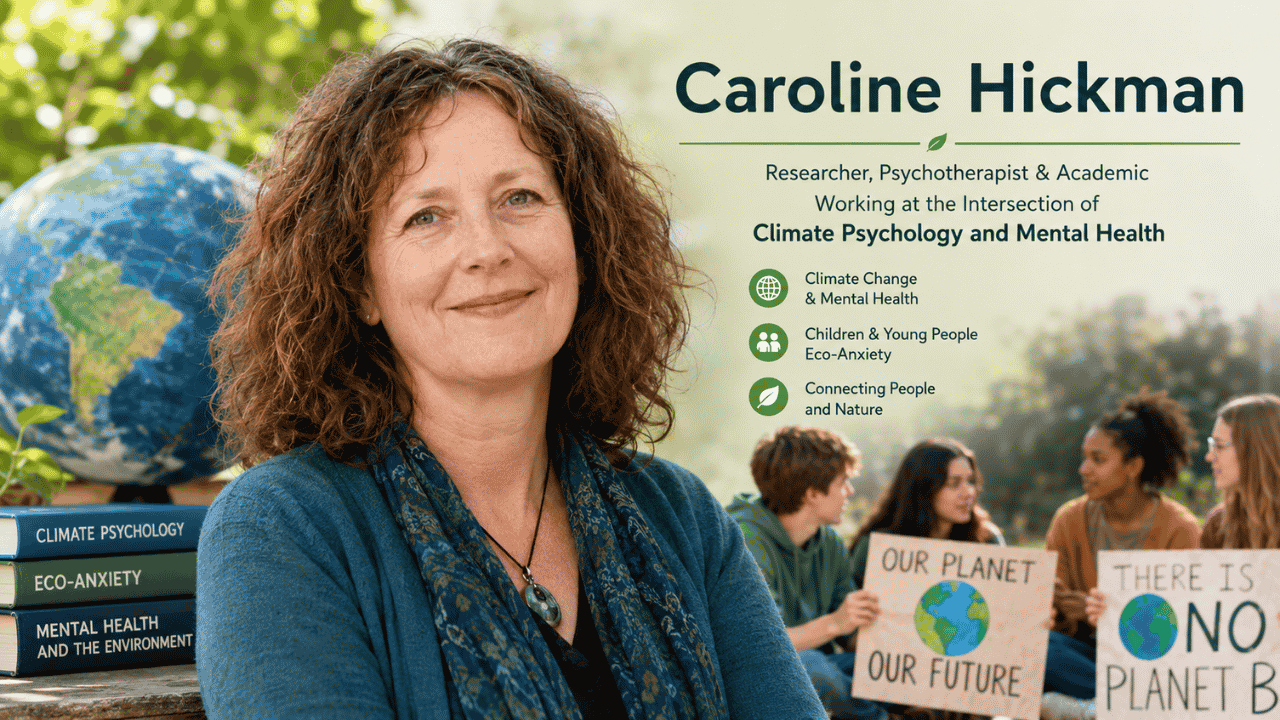
You may find several professionals with the same name as Caroline Hickman. One of the most prominent is Caroline Hickman, a British social work academic, psychotherapist, and researcher known for her work on climate psychology, eco-anxiety, and the emotional experiences of children and young people facing the climate and ecological crisis.
Caroline Hickman has developed a career that connects social work, psychotherapy, education, and climate psychology. Her work looks beyond the environmental effects of climate change and considers how ecological disruption can influence people’s emotions, relationships, sense of security, and mental well-being.
She is particularly interested in how children and young people understand the climate crisis and how adults, schools, therapists, and communities can respond to their concerns. Her research and professional activities have helped bring greater attention to eco-anxiety and climate distress.
Who Is Caroline Hickman?
Caroline Hickman is a lecturer at the University of Bath whose academic and professional work focuses on social work and climate psychology. She is also a practicing integrative psychosynthesis psychotherapist and researcher.
According to her professional biography, Hickman has worked in social work since 1983 and has practiced psychotherapy with children, couples, and adults for around 25 years. She has also worked with schools, parent groups, and youth activist groups, providing talks and workshops concerning the relationship between the climate and ecological crises and mental health.
Her work is notable because it brings several disciplines together. Rather than looking at climate change only as an environmental or political issue, she examines the psychological and emotional dimensions of living through ecological uncertainty.
The University of Bath identifies her as an academic expert in the psychology of climate change and eco-anxiety, including the experiences of children and young people.
Caroline Hickman’s Educational and Professional Background
Caroline Hickman’s professional journey began in social work. Her career in the field dates back to 1983, giving her decades of experience working with people and examining relationships, emotions, families, and social systems.
Her background in social work became an important foundation for her later academic and therapeutic interests. Social work often requires professionals to consider a person’s individual circumstances alongside wider family, community, and social factors. This perspective is also visible in Hickman’s approach to climate psychology.
Alongside social work, she trained as an Integrative Psychosynthesis Psychotherapist. Her professional biography also states that she studied archetypal and cultural psychology in London.
This combination of academic and therapeutic experience helped shape her interest in climate-related emotional distress. Instead of treating climate anxiety as a simple individual problem, her work considers how personal emotions can be connected to wider social and ecological realities.
Caroline Hickman and the University of Bath
A major part of Caroline Hickman’s professional identity is her connection with the University of Bath.
At the university, she has been associated with social work and climate psychology. Her research interests include the psychology of climate change, eco-anxiety, relationships between people and nature, and the experiences of children and young people.
The University of Bath lists Hickman among its climate-change academic experts, specifically identifying her expertise in climate psychology and eco-anxiety.
Her academic work has therefore helped connect climate-change research with questions traditionally explored in psychology, social work, education, and psychotherapy.
Caroline Hickman and Climate Psychology
Climate psychology is one of the most important areas of Caroline Hickman’s work.
Climate change can create many different emotional responses. People may experience fear, sadness, anger, grief, helplessness, uncertainty, frustration, or concern about the future. Hickman’s work examines these emotional reactions and asks how people can understand and respond to them.
Climate psychology does not simply mean encouraging people to feel positive about the environment. It involves recognizing that the climate crisis can create genuine emotional challenges.
Hickman’s approach also emphasizes the importance of understanding these emotions in context. Someone worried about climate change may not simply be experiencing an isolated psychological problem. Their feelings may reflect an awareness of real environmental threats and concern about how society is responding.
This perspective has become particularly important in discussions about children and young people.
What Is Eco-Anxiety?
Eco-anxiety is a term commonly used to describe distress, worry, fear, or other difficult emotional responses connected with environmental and climate change.
Caroline Hickman has written extensively about this subject. In a 2020 peer-reviewed article, We need to (find a way to) talk about … Eco-anxiety, she examined eco-anxiety as an emerging phenomenon. She discussed the emotional experiences of children and young people.
Her work emphasizes that young people may experience the climate crisis differently from adults. Their feelings can be influenced not only by environmental threats themselves but also by how adults respond to those threats.
Hickman’s research encourages people to listen seriously to children’s concerns rather than automatically dismissing them as irrational fears.
Caroline Hickman on Children and Young People
Children and young people are at the center of much of Caroline Hickman’s research.
Her research has explored how young people understand climate and biodiversity crises and how they emotionally respond to them. According to the contributor information associated with her research, this work has involved young people in countries including the United Kingdom, Sweden, Brazil, the United States, the Maldives, Nigeria, and Bangladesh.
This international dimension is important because climate change does not affect every community in the same way.
Children living in areas already experiencing environmental changes may have very different experiences from children who mainly learn about climate change through news, education, or social media. Hickman’s research seeks to understand these different experiences rather than treating climate anxiety as one universal condition.
Caroline Hickman and the Global Climate Anxiety Study
One of Caroline Hickman’s most widely discussed academic contributions is her involvement in research examining climate anxiety among children and young people.
A 2021 study published in The Lancet Planetary Health examined climate anxiety and young people’s beliefs about government responses to climate change. Caroline Hickman was listed as the first author, alongside researchers including Elizabeth Marks, Panu Pihkala, Susan Clayton, R. Eric Lewandowski, Elouise E. Mayall, Britt Wray, Catriona Mellor, and Lise Van Susteren.
The study investigated emotional responses to climate change and the relationship between those feelings and perceptions of government action.
This research helped demonstrate why conversations about climate change cannot focus solely on scientific information. People’s emotional responses and their perceptions of whether leaders are taking meaningful action also matter.
Why Government Action Matters in Climate Anxiety Research
One important theme in Hickman’s work is the relationship between individual emotions and wider social responses.
Young people may experience climate anxiety not only because they understand the potential consequences of climate change but also because they believe that adults and governments are not responding adequately.
This creates an important distinction.
Climate-related distress can be influenced by what people believe will happen in the future, but it can also be influenced by what they see happening in the present. When young people repeatedly hear about environmental risks but do not see sufficient action, they may experience frustration, distrust, anger, or hopelessness.
Hickman’s research has helped bring attention to this connection between personal emotional experience and broader political and social circumstances.
Caroline Hickman as a Psychotherapist
In addition to her academic work, Caroline Hickman is a practicing psychotherapist.
Her professional biography describes her as an Integrative Psychosynthesis Psychotherapist who has worked with children, couples, and adults. Her therapeutic background informs her approach to climate psychology.
Rather than separating emotional well-being from the environmental context in which people live, climate-aware psychotherapy can consider how ecological concerns influence a person’s thoughts, feelings, relationships, and sense of identity.
Hickman’s work therefore sits at the intersection of psychotherapy and environmental awareness.
Climate-Aware Therapy With Children and Young People
In 2024, Caroline Hickman contributed to the book Being a Therapist in a Time of Climate Breakdown. Her chapter, titled Climate Aware Therapy with Children and Young People to Navigate the Climate and Ecological Crisis, examines how children and young people can experience eco-anxiety in ways that differ from adults.
The chapter considers cognitive and emotional responses to ecological crisis and discusses approaches that can be used in therapy, at home, in schools, and outdoors.
One central idea is that therapists may need to understand climate and biodiversity concerns as part of the context surrounding a young person’s distress.
This does not mean that every emotional difficulty should be labeled climate anxiety. Instead, it means that therapists and adults should be open to the possibility that environmental concerns can influence the emotional lives of younger generations.
Caroline Hickman’s Research on Climate Change and Mental Health
Another important area of her work is the broader relationship between climate change and mental health.
In 2024, Hickman authored a chapter titled Climate change, mental health, and eco-anxiety in the second edition of the Routledge Handbook of Climate Change and Society.
The chapter examines the relationship between climate change and mental health, with particular attention to eco-anxiety and its impact on children, young people, and Indigenous people.
It also discusses psychosocial approaches to climate anxiety, including ecopsychology, climate-aware psychology, and climate justice.
This work reflects a broader theme throughout Hickman’s career: climate change can create psychological and social consequences that require more than purely medical solutions.
Is Eco-Distress a Mental Disorder?
One of the interesting questions surrounding climate psychology is whether distress about climate change should be treated as a mental disorder.
Caroline Hickman has challenged simplistic approaches to this issue. In a 2023 article co-authored with Elizabeth Marks, Hickman argues that eco-distress is not a pathology. However, it still hurts; the authors argue that climate and ecological distress can be understandable responses to real threats.
This does not mean that severe distress should be ignored. Instead, it suggests that professionals should distinguish between understandable emotional responses and situations where someone needs additional psychological support.
The distinction is important because labeling every climate-related emotion as a disorder could unintentionally dismiss the legitimate concerns behind those emotions.
Caroline Hickman and Social Work
Although climate psychology is now strongly associated with Hickman’s public profile, social work remains an important part of her professional background.
Her experience in social work provides a relationship-centered perspective on psychological and environmental problems.
Social workers often consider how family circumstances, communities, institutions, economic conditions, and wider society shape individual experiences. Climate change can intersect with all of these areas.
For example, environmental disruption can affect families, communities, housing, education, employment, and access to resources. Young people may therefore experience climate concerns alongside many other social pressures.
Hickman’s work demonstrates why climate psychology can benefit from perspectives outside traditional psychology.
Caroline Hickman as an Author and Researcher
Hickman has contributed to academic articles, book chapters, and specialist publications.
Her research record includes work on eco-anxiety, climate anxiety, climate-aware therapy, psychotherapy, social work, and the psychological effects of climate and biodiversity crises.
Her 2020 article on eco-anxiety explored the need to develop better ways of talking about the subject. Her later work has expanded the conversation toward climate-aware therapy and broader relationships between climate change and mental health.
This body of work has helped make eco-anxiety an important subject for researchers, educators, therapists, parents, and policymakers.
Caroline Hickman’s Work With Schools and Communities
Hickman’s work is not limited to academic publications.
Her professional biography states that she works with schools, parent groups, and youth activist groups. She provides talks and workshops exploring climate and ecological crises and their intersection with mental health.
This practical work is important because schools are places where children and young people can encounter climate issues regularly.
Teachers and parents may struggle to know how to respond when young people express fear or anger about environmental problems. Climate psychology can provide a framework for listening to those concerns while helping young people process difficult emotions.
Caroline Hickman and Youth Climate Activism
Young people have played a significant role in the global climate movement, and Hickman’s research has examined the emotional dimensions of that involvement.
Youth activism can provide a sense of agency and community, but activism can also expose young people to difficult information and emotionally challenging experiences.
Hickman’s work encourages adults to take young people’s concerns seriously rather than assuming that activism is simply a political activity without psychological consequences.
Listening, acknowledging uncertainty, and allowing space for difficult emotions can all be important parts of supporting young people.
Her Interest in Nature and Diving
An unusual detail in Caroline Hickman’s professional biography is her experience as a PADI diving instructor.
She has spent time working underwater in the Sinai region of Egypt and describes her relationship with the sea as an important part of her life.
This interest connects naturally with her wider professional focus on relationships between people and the natural world. Her work frequently considers how humans emotionally respond to environmental change and ecological loss.
Why Caroline Hickman’s Work Matters
Caroline Hickman’s work matters because climate change is increasingly being discussed not only as an environmental challenge but also as a human and psychological one.
People do not experience climate change as statistics alone. They may experience it through extreme weather, changing landscapes, biodiversity loss, uncertainty about the future, or concern for younger generations.
Children and young people may be especially affected because they are growing up with the knowledge that environmental conditions could change substantially during their lifetimes.
Hickman’s research encourages adults to listen to these concerns while avoiding both extremes: dismissing young people’s fears or assuming that every climate-related emotion represents a psychiatric disorder.
Are Caroline Hickman’s Views Only About Anxiety?
No. Although eco-anxiety is one of the most recognizable subjects associated with her work, her research covers a wider range of emotions and psychological responses.
Climate-related experiences can include grief, anger, sadness, fear, hope, empathy, connection, and motivation.
Understanding this broader emotional spectrum is important. People can experience distress while also finding meaning through relationships, community participation, activism, education, therapy, or engagement with nature.
For Hickman, the goal is not simply to remove uncomfortable emotions. It is also to understand what those emotions may be communicating and how people can respond constructively.
Frequently Asked Questions About Caroline Hickman
Who is Caroline Hickman?
Caroline Hickman is a social work academic, psychotherapist, and climate psychology researcher associated with the University of Bath. Her work focuses particularly on climate anxiety, eco-anxiety, and the experiences of children and young people.
What is Caroline Hickman known for?
She is best known for research and professional work concerning climate psychology and eco-anxiety, especially how children and young people emotionally respond to climate and ecological crises.
Does Caroline Hickman work as a psychotherapist?
Yes. Her professional biography describes her as an Integrative Psychosynthesis Psychotherapist who has worked with children, couples, and adults.
What does Caroline Hickman research?
Her research includes climate psychology, eco-anxiety, climate distress, children’s and young people’s responses to climate change, social work, psychotherapy, and relationships between people and the natural world.
What is eco-anxiety?
Eco-anxiety is a term used for emotional distress or worry connected with environmental and climate change. Caroline Hickman’s research examines how these experiences can affect children and young people.
Conclusion
Caroline Hickman has built a distinctive professional career connecting social work, psychotherapy, education, and climate psychology. Her research has helped expand public and academic discussions about climate psychology, particularly in relation to eco-anxiety and the emotional experiences of children and young people.
